‘A street, or a house front, or a mountain, or a bridge, or a river, or whatever, is not just “background”. Each also has a history, a “personality”, an identity that deserves to be taken seriously.’ Wim Wenders
At this remove in time I can’t recall exactly where or when I encountered the notion of the dérive. I can picture the room in which I read mimeographed outtakes from the Situationist text, “On the Poverty of Student Life”, but I don’t remember where the house was.
I do remember where I was the first time I consciously did my own version of a dérive and I can date it fairly accurately to late summer/early fall 1970. I spent many hours of a psilocybin “trip” wandering from my apartment near Gage Park to the area around Dundurn Castle, pinballing at stoplights, turning on reds, and heading straight through on greens, letting elements of the city itself push me along. The idea was to pay attention to sounds and scents, to constellations of people and traffic, grass and trees and concrete, without consciously registering “where I was”. I wanted to remake my hometown of Hamilton Ontario into a collection of sites of experience rather than a grid of streets with names and numbers and neighbourhoods with names.
At the end of this long wander it was night and dark and I remember gazing up at the lights on in apartments in highrises and imagining the feeling of living so high above the ground with all that space beneath my feet. I ended up at a friend’s apartment, in one of those highrises, and was assaulted with his latest purchase, Black Sabbath, and I wondered about his taste in music.
I was 19 years old and already beginning to move beyond an explicitly political period that had begun with joining a Coordinating Committee to End the War in Vietnam in February 1967 and began to end as I listened to a previously indifferent friend rail on about the Kent State killings in May 1970. The sudden outpouring of opposition to and outrage over the Vietnam War as a response not to the 100s of thousands of slaughtered Vietnamese but to the deaths of 4 white college students depressed and embittered me.
Long before the dérive, an explicitly “political” technique, there was the flâneur. Without being conscious of it, in my teens and early 20s I encountered Baudelaire’s flâneur in Sartre’s novels, in the many books I’d read by Aldous Huxley, and in different senses in the works of Andre Gide. The aimless urban wanderer, floating above the social world he observes, unconnected to and alienated from the human realm in modernity, the flâneur partakes of the divinity of Joyce’s artist “paring his fingernails”, a pure observer of the mundane world.
Between the late 19th and early 20th century time of the classic Baudelairean flâneur and the mid-20th century Situationist dérive there was a surrealist variant that highlighted the role of pure chance and randomness in urban wandering that aimed to find some reality beyond the banal reality of the city. Where the flâneur practiced distance and mild cynicism to achieve clarity of observation, and the dérive was intended to subvert the capitalist control of our experience of cities, the surrealists were reaching for a transcendent grasp of a deeper reality obscured by the material surfaces of things.
When I first spent long periods of time in Bangkok, I often applied these European styles of “urban hiking” to my explorations of the city. I would look at a large map I kept in my hotel room, pick a destination more or less at random, then flag a taxi to take me there. The goal was to then walk back to my hotel following my vague memory of the map. I rarely ever made it all the way back, grabbing a ubiquitous taxi to take my sweating exhausted carcass “home”, but I often found myself exhilarated by the random discoveries I made this way, discoveries that very deliberately had nothing to do with tourist sites.
In those days I carried no camera. In fact, outside of a brief flirtation with a Nikkormat loaded with Tri-X in the mid-70s, I spurned personal photography. Somewhere along the line I became convinced that snapshots and travel photos actually destroyed memories by replacing them with images on paper. I have absolutely no regrets about all of those unrecorded moments and places in my travels around Europe, a trip to Costa Rica, short stays in Tokyo and long months and weeks backpacking around SE Asia on buses, boats, trains and planes.
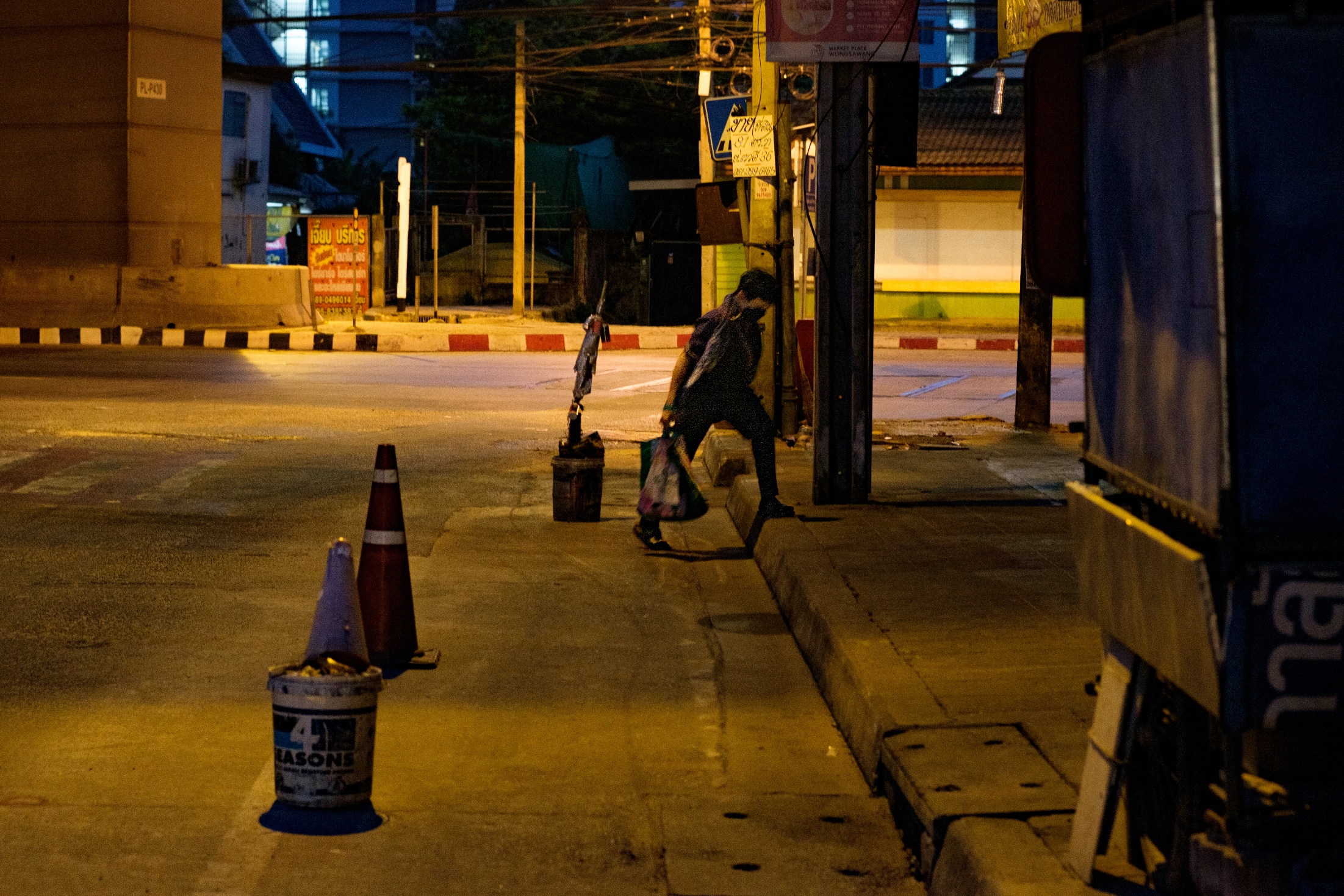
But the longer I lived here, in Nonthaburi, a “suburb” of Bangkok, the more I felt a desire to make images out of the images I saw around me.

